

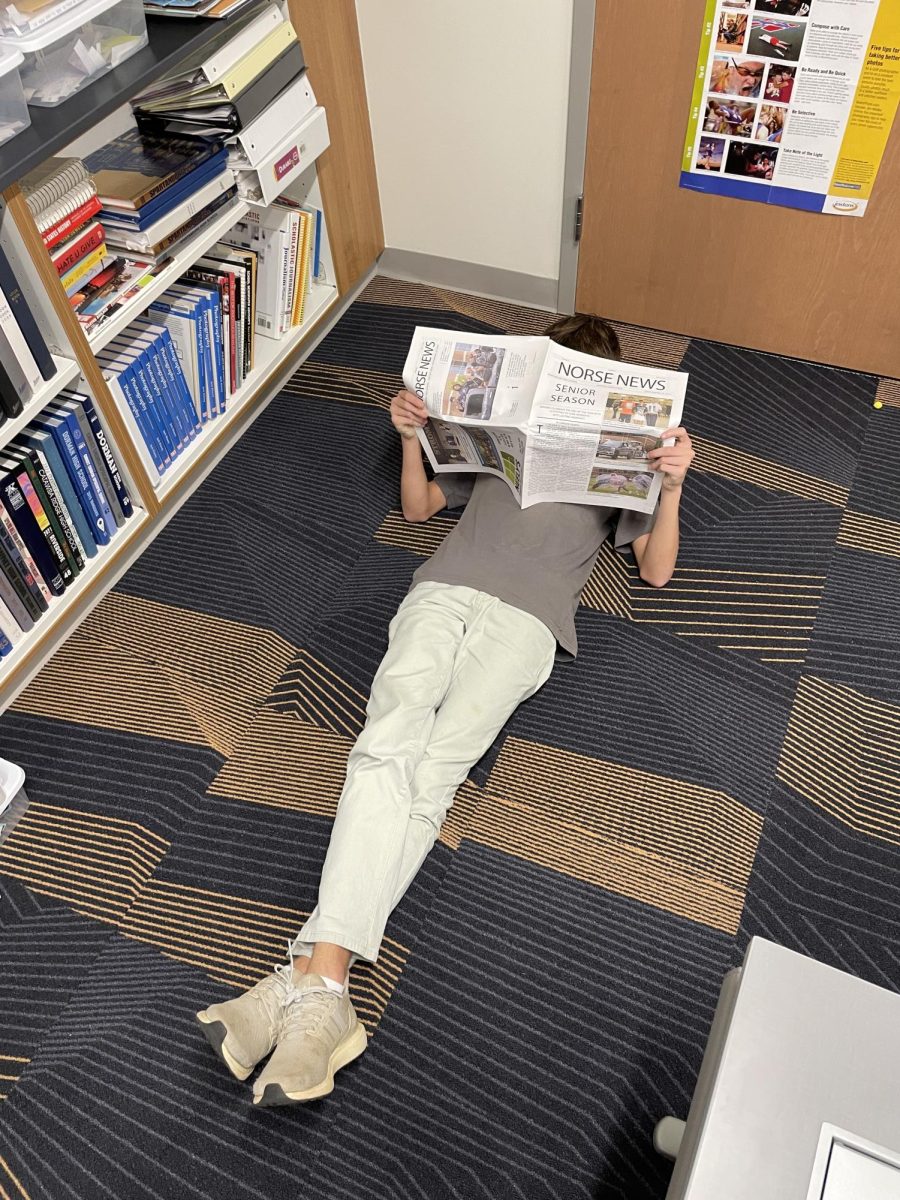
After a long day full of work, school or practice, sometimes all one wants to do is relax. Coincidentally enough, the resource to do that is right beneath them. Sure, there are beds, chairs and other spots to relax, but it’s often easiest to just lie down on the ground or floor to decompress. Why is this easy method so relaxing, though?
This is due to simple psychophysiological correlations between the mind and body. The two often align with each other, like how slouching or slumping can be associated with negative moods. Despite limited research on the matter of lying on the floor, psychologists assure that these correlations are present in this situation as well.
In a New York Times article, Ellen Hendriksen, a clinical psychologist, notes that lying down on one’s back creates physical relaxation and decompression, which correlates to emotional ease.
“When you lie flat on your back, your posture is open and relaxed, which may have a calming effect,” Hendriksen said.
This phenomenon may also correlate with the concept of grounding, which involves bodily contact and connection with the earth itself. This involves lying down in areas of nature, like in a park or the grass, or it could be just walking barefoot on the ground. Studies have proposed scientific theories explaining the benefits of grounding, saying that the natural electric charge of the earth let electrons be absorbed by the body, which possibly reduces inflammation, stress and improves sleep.
Although some psychological benefits of lying on the ground or floor have been identified, longer rests on hard or stiff surfaces can be harmful. Hard surfaces may lead to joint stiffness and unwanted pressure points that can restrict blood flow. The human body is also naturally shaped in a way that isn’t suited for flat surfaces, hence the need for mattresses and beds. The spine features a natural curve that, when misaligned, creates pain.
In an article from Scientific American, Peter Whang, a professor in the Yale Department of Orthopaedics and Rehabilitation, details this physical attribute and how flat surfaces may cause harm to the body.
“We have physiologic curves. One such curve leaves space between the lower back and the floor. Lacking support, this curve flattens out over time, which can result in back pain,” Whang said.
There’s an extent to the support that is needed for the spine, though. Super soft mattresses can actually be harmful to one’s back. According to Healthline, soft mattresses may cause the body to sink too much and force the spine to curve, therefore creating more back pain.
Combinations of firm surfaces and soft supports have been found to be suitable solutions for longer-term resting. Many cultures from around the globe, including Japan and Korea, traditionally sleep closer to or on the floor with padding or bedding in addition.
Flat surfaces can still be utilized for physical benefits, though. Intentional use of walls or flat surfaces can help with postural issues and can build strength, especially in rehab settings.
Julian Roberts, an athletic trainer at Spartanburg High School, sometimes uses flat surfaces in this manner to assist student athletes.
“A lot of our athletes, especially overhead, lack posterior chain strength, leading to a tight chest, rounded shoulders, and overall bad posture. Using a flat surface with intention can help with building posterior chain muscle tension and activation to alleviate the effects of bad posture,” Roberts said.
Lying on the floor is a simple yet complicated endeavor, yielding some psychological benefits but also prompting the potential of harmful physical effects. If utilized properly, though, flat surfaces like the floor or the ground may provide physical benefits.