

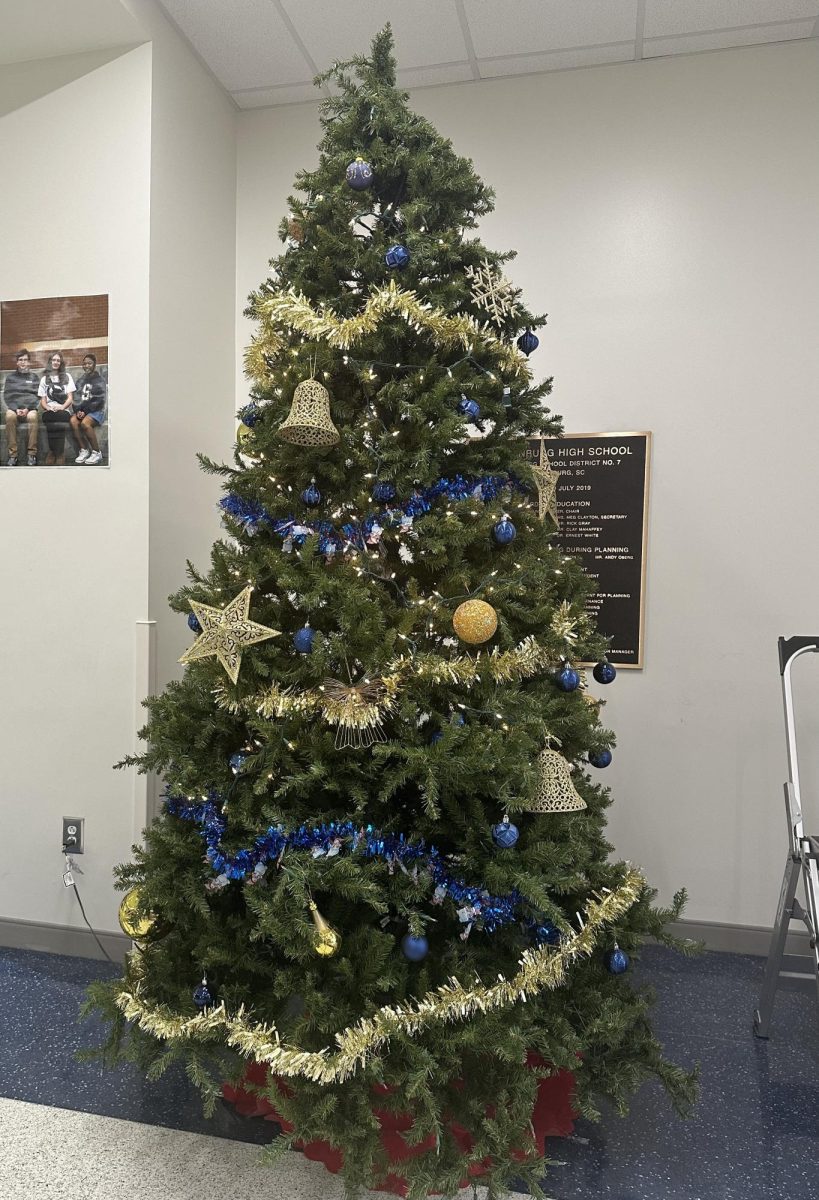
As December rolls around and Christmas decorations go up, the old-time tradition of Christmas trees brightens homes. Stemming from ancient pagan tradition, Christmas trees are a symbol of hope and renewal. Decorating them is a family tradition with styles variating globally. In Germany, where the tradition is said to have started, trees are decorated with homemade ordainments made of apples, straw, wood, and nuts.
When decorating, people are struck with the choice of a real Christmas tree or an artificial one. In the late 1800s, the first commercially-produced artificial trees hit the markets. Intended to combat deforestation, the tree was crafted with dyed-green goose feathers. Later in the 1930s, the first bristle brush tree appeared that led to mass production in the 1950s and 1960s.
Artificial Christmas trees are popular because of their simplicity. They are very low maintenance because no watering is needed, and the cleanup is close to none. These trees can be used year after year, saving money over time. They also come in a variety of different styles that can be chosen depending on the person’s taste.
Roslyn Owensby’s (11) family decorates a artificial tree for Christmas.
“I like the simplicity of having a fake tree, putting it up the same every year, choosing the lights with a remote, and having the same tree for Christmas every year. I feel like real trees will go out of style because of the technology able to us with fake trees. I have a fake tree that changes lights by remote and lights up directly when you put it together. Trees like mine that are simple and easy will soon replace real trees for their advances,” Owensby said.
The already-attached lights to artificial trees is another benefit from them. Users don’t have to take the time to set up lights. With certain models, they can choose a light color and change it whenever they want.
While fake trees come with many benefits, some think real Christmas trees are more authentic. It’s a common family tradition to go to a Christmas tree farm to pick out a tree. Local Christmas tree farms support community businesses and provide cleaner air for the area.
Riley Nolan’s (10) family has used the same artificial tree since she was little.
“While my family does not buy live trees, I do think it’s important to support local businesses despite what they are selling. In a world of rapidly growing big businesses and chain stores, we tend to forget about what makes our city and community special: the people working behind the scenes imbuing passion in everything they do,” Nolan said.
Real trees are easier to recycle than artificial ones, making them better for the environment. Once the trees are disposed of, they can be turned into mulch or compost for gardens and yards. Throwing the trees into ponds or lakes creates habitats and food for fish and turtles.
Javian Smith (12) has grown up using an artificial tree.
“I think having a real tree is more authentic than a fake one, but I still prefer the fake one. A real tree would be better for the environment because they are recyclable while fake trees are hard to recycle,” Smith said.
Real Christmas trees come with many environmental benefits while artificial trees are an uncomplicated alternative. Christmas trees are a symbolic custom whether the tree is artificial or not.