

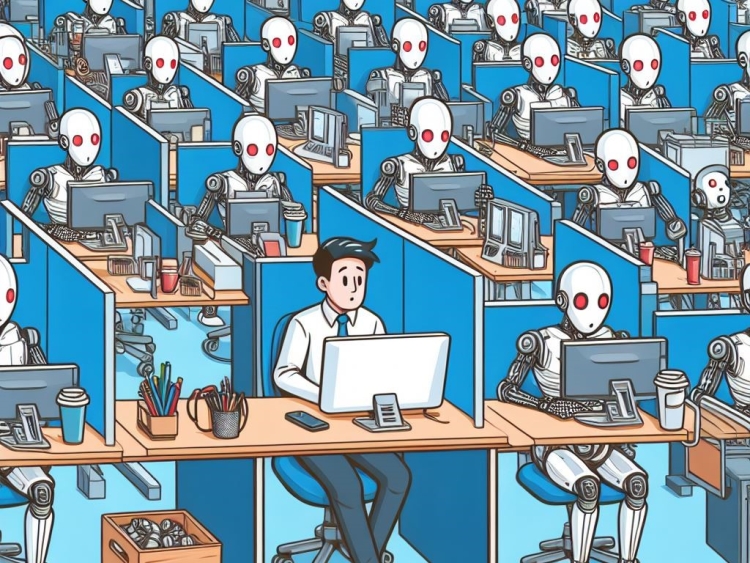
As 2026 unfolds, the global workforce is undergoing its most profound transformation since the advent of the internet. For the current generation of high school students, the “future of work” is no longer a distant concept discussed in textbooks; it is a live reality defined by a massive surge in productivity and a complete restructuring of traditional career paths. The rise of artificial intelligence (AI), autonomous systems capable of reasoning and executing complex workflows without constant human oversight, has created a world where machines are not just assisting humans but often outperforming them in both speed and volume.
The most striking feature of the 2026 labor market is the Speed Gap. According to pwc.com, a renowned data analysis website, “recent economic data indicates that in sectors heavily integrated with AI, such as finance, software development and administrative services, productivity has increased by nearly 27% since 2024.” AI agents now handle approximately one-quarter of all work tasks in the U.S. and Europe, operating at a pace that is effectively twice as fast as the average human worker. While a human professional might spend days drafting a legal brief or reconciling a month of financial data, an AI agent can finalize these tasks in seconds, working 24 hours a day without fatigue or error.
Ellen Long, an Advanced Placement Research teacher at Spartanburg High School, offers her insight into the changing job market.
“While AI is becoming increasingly prominent today, I still do not believe it has come to its full capacity regarding taking over working-class jobs. AI is a good tool for many workers and civilians alike if they use it wisely, which is why we should always limit its control over our minds,” Long said.
However, this AI takeover is more nuanced than a simple replacement of people with robots. Instead, society is witnessing a massive displacement of specific roles. According to the World Economic Forum, “estimates for late 2026 suggest that up to 85 million jobs globally are being transitioned into automated systems. High-exposure roles, those that involve repetitive data handling or predictable communication, are vanishing.” Entry-level positions in customer service, retail and even junior-level coding have been largely absorbed by AI. For students, this means the “stepping-stone” jobs of the past are disappearing, replaced by a demand for workers who can oversee and “orchestrate” these AI systems from day one.
Riley Haggerty (11) is a student who witnesses AI in her daily life, and gives her opinion on how it is taking over jobs.
“I think AI has its good and bad effects. I think it is good because we are developing new and faster ways to do things. Bad because it can make unemployment rates grow, and it may not be as effective,” Haggerty said.
This shift has created what economists call the “Hourglass Economy.” At the top, there is a high demand for strategic leaders and creative thinkers who provide the vision that AI cannot. At the bottom, there is still a need for physical, human-centric labor that machines cannot yet replicate. The middle-tier roles, the traditional white-collar “busy work,” are the ones being squeezed by AI’s efficiency.
Success is no longer measured by how much “work” one can produce, but by how well one can direct AI agents to produce it. This requires a new set of “power skills:” high-level critical thinking, ethical judgment and deep emotional intelligence. While AI can process information twice as fast as a human, it cannot navigate complex social nuances or provide genuine human empathy.
While it is true that AI is taking over many jobs and working at a pace humans cannot match, it is also creating a massive “wage premium” for those who know how to use it. In 2026, workers with AI fluency are earning significantly more than their peers. For today’s students, the challenge is not to compete with the speed of the machine, but to master the uniquely human skills that give that speed purpose. The future does not belong to the fastest worker, but to the smartest director.