

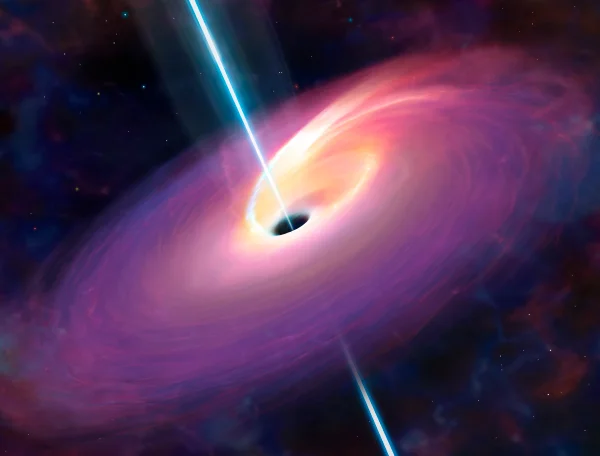
For a long time, black holes have been treated like the universe’s trash compactors – dark, hungry voids where light and time go to die. Scientists have theorized that if a human were to fall in, they would simply disappear, stretched into spaghetti and deleted from existence.
But a haunting new theory called “Frozen Light” suggests that black holes might be the universe’s most interesting libraries, preserving a strange, shimmering form of “life” at the very edge of the abyss.
To understand this, scientists look at the event horizon. According to the Space Telescope Science Institute (STScI), “The invisible tripwire of a black hole is shown, because of the way gravity warps time, an object falling toward that edge appears to slow down to a crawl from our perspective.”
An object never quite “falls in.” Instead, it becomes a smear of light, frozen in time, reddening and dimming but staying etched on the surface of the hole forever. This isn’t just a physics trick; it’s the holographic principle, the idea that everything a black hole eats is stored as data on its surface.
David Millinor (11) expresses his interest in this discovery.
“This theory is extraordinary and really cool. I think it will help us better understand space and the time elapsed that occurs in black holes. I also think that there is a relation to light travel and black holes, as light actually can be trapped inside black holes. As a science nerd, I find it interesting to learn and research these concepts,” Millinor said.
Some scientists are beginning to wonder if a black hole isn’t a tomb, but a sanctuary. Imagine a form of life not made of flesh and bone, but of pure energy and data, thriving on the intense radiation swirling around a dark center. To an observer living in that “frozen” layer, a thousand years in the outside world might pass in a single heartbeat. They would be the ultimate survivors, watching the entire history of the universe flicker by like a fast-forwarded movie.
Mathilde Sexeny-Hauser (11) provides further details and concern for the outcome of this topic.
“It’s honestly terrifying to think that if you fell into a black hole, you’d just be frozen there like a glitch in a video game while the rest of the universe keeps moving on without you. If it were me, I would not know how I would feel, being in an endless time warp frozen in time,” Sexeny-Hauser said.
There is also something deeply human about this paradox. People spend their lives terrified of the “void,” yet here, people find that the most powerful voids in the cosmos might be the only places where things truly last. Every photon of light that hits a black hole becomes part of a permanent record, a cosmic hard drive that never crashes.
People used to look at black holes and see nothingness. Now, people are starting to see them as glowing archives, holding onto the light of everything they’ve ever touched. In the coldest, darkest corners of space, this generation may have finally found the one place where nothing is ever truly forgotten.